Abdul El-Sayed Falsely Claims He ‘Erased’ $700 Million in Medical
This story raises questions about governance, accountability, and American values.
That bright yellow "$700 MILLION MEDICAL DEBT ERASED" caption isn't just campaign puffery. It's a falsehood, and it's the entire basis of Abdul El-Sayed's first major TV ad in the Michigan Senate race. The truth is more modest and far less exciting: his nonprofit bought distressed medical debt for pennies on the dollar and then forgave whatever it could.
New Republican Times Editorial Board
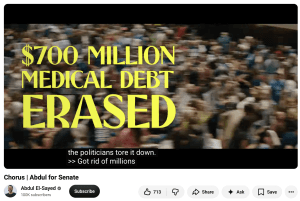
El-Sayed, an evangelist for ‘Medicare for All,’ has made multiple false and misleading claims about his achievements in public health So boasted the first major TV ad for Abdul El-Sayed’s Senate campaign in Michigan—in a bright-yellow, all-caps caption blanketing the screen, as the voice-over said that El-Sayed "got rid of millions of dollars of medical debt." This claim referred to an initiative El-Sayed launched during his roughly two-year tenure as head of the Wayne County health department, which serves the Detroit suburbs.
The county budgeted several million dollars from what it has described as a combination of federal American Rescue Plan Act funds and a local indigent health fund—to buy up low- and middle-income residents’ medical debt for a tiny fraction of the outstanding bills.
The program applied to all of Wayne County, including Detroit, which has a 35 percent poverty rate . How much medical debt did this program actually erase by the time El-Sayed, a progressive Democrat, left the health-department post in April 2025 to pursue the Senate seat?
That's 17 times smaller than what the campaign ad boasted. El-Sayed's claims about erasing Michanders' medical bills are fundamental to his campaign, as he champions "Medicare for All," a pledge the progressive left has identified as a winner in the midterms.
On Tuesday, El-Sayed released a new video about healthy eating, introducing himself as "an actual doctor," a claim that is also contested. To evaluate El-Sayed's medical-debt-relief effort, the Washington Free Beacon reviewed numerous documents obtained through Freedom of Information Act requests.
These records reveal that the candidate's frequent references to the debt-relief program have often been misleading or provably false. Roxie Richner, an El-Sayed campaign spokeswoman, did not defend the vast disparity between the $41.7 million and $700 million figures when contacted by the Free Beacon .
Instead, in a statement, Richner wrote: "Abdul is proud to have spearheaded a program that has erased tens of millions of dollars in medical debt for tens of thousands of Michigan families." The campaign has also claimed that the program he launched in Wayne County is on the path to canceling $700 million in debt.
But given the refusal by two of the county's top hospital systems to participate, the program's final tally will likely remain a fraction of that sum. Nine days after El-Sayed's inaugural campaign ad debuted on June 16, Bridge Michigan reported that by that point, the ongoing debt-cancellation program had erased only $57.4 million—still a far cry from the $700 million that the ad claimed.
A county-run dashboard has since upped the debt-cancellation figure to $95.8 million. Since the Bridge Michigan article's publication, El-Sayed and his campaign materials have pivoted to offering vaguer accounting of the debt relief.
A few weeks before the primary vote, Rep. Haley Stevens, El-Sayed's Democratic opponent, on July 13 posted the article on X and retorted that "aspirational goals aren't real results." El-Sayed responded July 14, saying that "because we've erased tens of millions of the hundreds of millions of medical debt our program is on track to erase for 300,000 Michiganders." In a Sept. 5 iteration of his stump speech, El-Sayed said of his work leading the Wayne County health department that "when we found out that our county ranked number eight for medical debt nationwide, and we realized that we could eliminate all of that debt for pennies on the dollar, we set aside $7 million to erase up to $700 million of medical debt in what is the largest medical debt erasure in Michigan state history." Many of these assertions falter under scrutiny.
El-Sayed's claim about the record-setting status of this initiative, which he's made multiple times , would only be accurate if he weren't still conflating aspiration with accomplishment. This includes the suggestion that the county could wipe out all of the local medical debt, which, given the program's income-cap eligibility criteria, it was never set up to do anyway.
According to the most recent quarterly report to the county from Undue Medical Debt , the New York City-based nonprofit contracted to run the debt-relief program, it had canceled $91.7 million in debt through June 2026, benefiting just under 100,000 Wayne County residents.
But a separate, Michigan state-funded $4.5 million contract, also with Undue, that was launched in 2024 and is currently slated to run through September 2028, has already canceled more than twice that amount.
Governor Gretchen Whitmer, a Democrat, announced June 22 that Michigan had purchased over $200 million in medical debt for over 280,000 state residents. And yet El-Sayed has continued to call his plan the biggest.
The Wayne County debt-relief program, which began in March 2024 and was initially meant to run only through 2025, is currently slated to wrap up its one-year extension on Dec. 31. Based on the program's track record and its pending debt-purchase arrangements, there's little indication that the plan will approach anywhere near $700 million in debt relief for 300,000 residents by year's end. (The county's web page on the program also cites that projected dollar figure, but says it would apply to 200,000 residents.) And yet El-Sayed has continued to claim the county program will achieve that remarkable feat.
Granted, the second quarter of this year saw a sizable jump, thanks to a $29.2 million debt package bought for just under $250,000 from a single Wayne County federally qualified health center. And El-Sayed's successor at the health department, Kennyle Johnson (a black woman who, as the Free Beacon reported , is paid less than El-Sayed was even as he has denounced the pay gap for this demographic), suggested at an Aug. 27 county hearing that more deals with such health centers, which serve low-income patients, are in the works.
So it remains possible that the tally could rise substantially. Johnson also testified that the county is "going to be looking to renew the contract with Undue Medical." "A lot of contracts, we amend them two or three times," Terry Marecki , a Republican Wayne County commissioner, told the Free Beacon .
According to legislative records the Free Beacon obtained and the original contract with Undue, however, the local government only authorized one option to renew for 12 months. So extending the contract again would require a new mandate from the County Commission.
An Undue spokesman said, "We've had conversations with the county about what the program could look like moving forward, but we haven't received a formal extension or new amendment. We can't speculate about what the county may decide to do before the end of the year." "Whether or not it's to be extended, that's still to be determined," Matt Allen, communications director of Wayne County, said of the contract. "We continue to engage providers and pursue opportunities to maximize the County's investment," the Undue spokesman added. "We anticipate making some additional purchases soon." The health department's 2024 contract with Undue indicated the county had set aside $5 million to purchase medical debt for lower- to middle-income or otherwise heavily debt-burdened local residents.
The contract projected that the power of these funds could be magnified a hundred-fold, to purchase up to $500 million in medical debt from local health care providers. El-Sayed had initially detailed a $7 million budget, according to a Nov. 1, 2023, email he sent to colleagues in which he said that 89 percent of the cost would come from local indigent funds. (That cash comes from airport parking fees and cigarette taxes, per legislative documents.) But the Wayne County Commission —the local legislative body—only ever approved $5 million.
In a December 2024 release , the county stated: "An additional $2 million could be added in the future should it be needed." However, the Undue spokesman told the Free Beacon the extra $2 million "was never pursued," and the $700 million projection was based on "anticipated provider participation"—making it arguable that continuing to cite that dollar figure amounts to a budgetary sleight of hand.
According to Undue's most recent report to the county, it spent a cumulative $1.1 million to cancel the $91.7 million in debt through the year's second quarter. Despite these accounting specifics, the claims about the debt-cancellation program on the El-Sayed campaign's "Meet Abdul" page remain unchanged since it went online in April 2025 .
The text claims the candidate "spearheaded a program that will cancel up to $700 million in medical debt for 300,000 Michiganders over two years." And on Dec. 10, 2025, with three weeks left in that initial just-under-two-year contract , the El-Sayed campaign made a nearly verbatim claim in a news release .
Such bravado notwithstanding, the debt-cancellation program achieved just 8 percent of that ambitious dollar amount during the original contract period, according to an Undue report. The gulf between the program's lofty promises and its more humble reality has apparently been driven by a refusal by some major hospitals to participate.
Independent Michigan journalist Kayleigh Lickliter reported in May that of the three top hospital systems in Wayne County, Henry Ford Health was the sole participant in the debt-purchase program. And the hospital had agreed to sell just $17 million in debt.
Records the Free Beacon obtained indicate the limit of the program's ambitions had already become apparent within months of its launch. According to slides from Undue's most recent report, Detroit Medical Center, or DMC, has remained "Unresponsive since March 2024; many follow-up attempts; Parent org said no." Corewell was "Not interested." From the Karmanos Cancer Institute, a subsidiary of McLaren Health Care, there was: "No response from outreach attempts." In an Oct. 31, 2024, email to El-Sayed that the Free Beacon obtained, Allison Sesso , Undue's president and CEO, relayed a list of hospitals and said that "we haven't been able to get the following providers on board yet," including those mentioned in the recent report plus Ascension Michigan.
Internal emails indicate that El-Sayed had personally lobbied Corewell, but evidently failed to reel them in. Sesso said Undue thought "it is prudent to discuss the size of the overall grant to see if we should adjust the amount given the ARPA reallocation deadline of Dec, 2024"—referring to the date when unused federal dollars would supposedly be lost. "After this discussion, Wayne County and Undue agreed to continue engaging providers," the Undue spokesman told the Free Beacon . "As of now the grant remains for $5 million." A representative from McLaren declined to comment.
None of the other hospitals returned requests for comment. Cook County, which includes Chicago, recently leveraged $9 million in federal ARPA funds to cancel over $1 billion in medical debt for nearly 800,000 residents through an Undue contract, thanks to robust participation by local hospitals.
Richner, El-Sayed's spokeswoman, said of him: "As a United States Senator, he will fight to eliminate medical debt and guarantee affordable healthcare for every single American by passing Medicare for All." Referring to El-Sayed's Republican opponent, former Representative Mike Rogers, he continued: "In stark contrast, Mike Rogers spent years in Congress spiking healthcare costs for Michigan families as Big Pharma's self-described 'champion.'" The "champion" reference apparently relates to Rogers reflecting to journalists investigating the opioid crisis on why those tied to the pharmaceutical industry were heavy donors to his congressional campaigns.
He said in 2016 of such donors: "I think they said, 'This guy is a champion, he's doing something we believe in and we want to support guys like that.'" Rogers's campaign did not return a request for comment.
In a statement to the Free Beacon , Warren C. Evans, executive of Wayne County, focused on the debt-cancellation program's benefits over its shortcomings. For the over 100,000 impacted residents, he said, "this gave them relief that they hoped for and greatly needed in their lives at pennies on the dollar to the county." El-Sayed's puffery about medical debt is one link in a chain of false or embellished claims that he has made during his bid for a seat that could decide the balance of power in the Senate.
As the Free Beacon previously reported , he falsely claimed to have "removed" lead from Detroit's public schools during his 18-month stint as the city's health director, which he cut short by launching his ill-fated 2018 gubernatorial bid.
He also claimed that while heading the county health department, he cleaned up a troubled local juvenile jail—despite a subsequent inspection that found it was still plagued with problems. And his campaign greatly exaggerated how many free pairs of eyeglasses he secured for children during his health-director tenures. "The El-Sayed campaign has been fairly fast and loose with the facts," said Adrian Hemond , CEO of Grassroots Midwest, a Michigan-based bipartisan consultancy.
Rogers, Hemond added, "hasn't been much better." "Campaigns know most voters are in no position to evaluate factual claims," Hemond said. El-Sayed's résumé, as the Free Beacon has reported, is marked by unfinished business—relatively brief tenures in serious jobs that would normally demand years-long commitments, including one prestigious academic post he accepted but apparently never began.
He persistently refers to himself as a "doctor" or "physician" when he's never been licensed to practice medicine. After receiving an M.D., he never did a residency, opting instead to work as a public-health scholar and administrator, separated by stints as a public speaker, podcaster, and political candidate.
Medical debt is a serious problem nationwide, as health care costs generally rise faster than inflation and the medical system remains fractured . It has emerged as a major issue in the Kansas Senate race given that the Republican incumbent, Roger Marshall, an obstetrician, has come under attack for suing patients for unpaid bills.
In his July 2024 testimony before a Senate health committee, El-Sayed pointed to an analysis of Census Bureau data that found that nearly 1 in 12 adults harbor medical debt—a $220 billion national burden.
About 14 million, or 6 percent of adults, owe more than $1,000, and 3 million, or 1 percent, owe more than $10,000. But medical debt is an elastic concept. Hospitals know when treating low-income patients that they will be unlikely to recoup large uncovered bills from the patients themselves.
They often bill much of the debt retroactively to Medicaid, get Medicare reimbursement, or write it off as charity. Debt relief, in which a state or local government buys debt for a tiny fraction of the sticker price, is often a last resort.
One recent study , which was built upon two randomized experiments, found that cancelling $169 million of debt for over 83,000 people yielded "no effects on survey measures of mental and physical health, healthcare utilization, and financial wellness." But the promise of relieving such debt dovetails with El-Sayed's campaign promise to deliver Medicare for All, under which the government would pay for health care across the board—or at least fill in the remaining cracks left by the Obamacare overhaul with a public option.
Published under: 2026 elections , Abdul El-Sayed , Haley Stevens , Health Care , Health Insurance , Michigan
Original source:
Read at Free BeaconHow We See It
New Republican Times Editorial Board
That bright yellow "$700 MILLION MEDICAL DEBT ERASED" caption isn't just campaign puffery. It's a falsehood, and it's the entire basis of Abdul El-Sayed's first major TV ad in the Michigan Senate race. The truth is more modest and far less exciting: his nonprofit bought distressed medical debt for pennies on the dollar and then forgave whatever it could. That genuinely helps some struggling patients. But it is not "erasing" $700 million in any real economic sense, and the voice-over's softer claim about "millions" only proves the caption knows it's stretching. It's a lie wrapped around a kernel of truth.
Why does the distortion matter? Because El-Sayed is asking voters to send him to Washington on the strength of this ad. If the facts were impressive on their own, he wouldn't need an inflated number in all caps. This is the Sanders-style left's favorite trick: take a small, worthwhile program and rebrand it as a miracle. The debt wasn't erased. It was bought at a discount and retired. Patients are better off, and fine. But a candidate who opens his campaign with a claim that doesn't survive a basic fact-check is telling you something about how he views the public.
There are plenty of real issues in this race, from the border to inflation to Michigan's cost of living. Instead, El-Sayed's team decided voters would accept a giant number if it was bright enough. Treating people like they can't do arithmetic is a choice. It's also an insult. And if he'll bend something this easy to verify, imagine what he'd do with the enormous, unaccountable power of the U.S. Senate. The ad does the damage to itself. Truth in advertising is a low bar, and he just tripped over it.
Commentary written with AI assistance by the New Republican Times Editorial Board.