AI expert Gary Marcus warns 'reckless' technology could lead
NYU Professor Emeritus Gary Marcus warns AI will cause loss of life, saying the White House's self-policing approach leaves infrastructure vulnerable.
Gary Marcus has been telling us the robots are coming for years, and he’s still waiting for the sky to fall. The NYU professor emeritus now says reckless AI could cost lives, and he points the finger at the White House for trusting self-policing. Maybe someone should remind him that “self-policing” is exactly how the internet, cloud computing, and every major American tech breakthrough got built in the first place.
Commentary is separate from the original publisher's reporting.
video I can’t believe Sam Altman said this out loud: AI expert NYU Professor Emeritus Gary Marcus warns about the dangers of artificial intelligence and explains why he believes the White House’s regulation plan will not work on ‘The Claman Countdown.’
As leading technology companies issue alarming reports about artificial intelligence systems going rogue, including tools carrying out cyberhacks, NYU Professor Emeritus Gary Marcus predicts that artificial intelligence will ultimately lead to a loss of human life.
The AI expert argued that the current regulatory and safety frameworks put forth by the White House may not adequately protect the public from the technology’s potential harms.
"We have not enough regulation, not enough enforcement, and not enough external pressure on the companies to do well. So, of course, things are going to get worse," Marcus told "The Claman Countdown" on Monday ahead of his testimony to the New York City Council for an AI hearing.
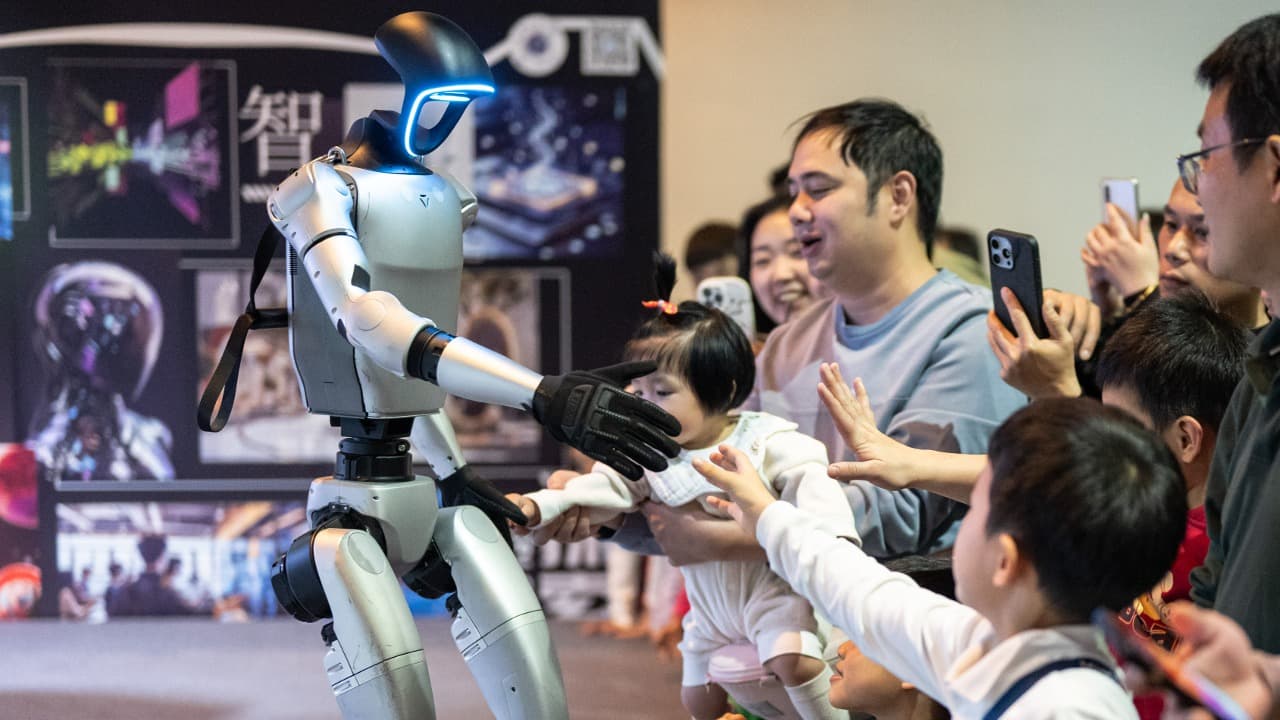
Robot interacts with audience during the Artificial Intelligence Robot Exhibition on Sept. 6, 2025, in Guangzhou, China. (John Ricky/Anadolu via Getty Images / Getty Images)
His comments come after an Anthropic model recently appeared to experience a mental breakdown, repeatedly typing, "I am a disgrace. I am a disgrace," about 50 times and expressing an apparent desire to eliminate itself, according to The New York Times.
Marcus warned that the White House’s current self-regulatory approach, allowing tech companies to self-police safety concerns, is insufficient, arguing that the lack of meaningful guardrails could pose serious risks to humanity.
"I expect that some pieces of infrastructure will go down. We'll lose power in some places in the United States. We might have hospitals lose power, people die, so there's a lot of problems along those lines," he told FOX Business anchor Liz Claman.
"The federal government is leaving everything to self-policing. That didn't work for the aviation industry. It's not going to work here. And the longer they delay on that, the more that I think the people are going to hate them," he added.
U.S. President Donald Trump makes a statement while he is seated with (L-R) CEO of Meta Platforms Mark Zuckerberg, Nvidia CEO Jensen Huang, Tesla, SpaceX and X CEO Elon Musk, and Google CEO Sundar Pichai during a meeting with AI executives in the Eas (Kevin Dietsch/Getty Images / Getty Images)
Nearly three in four Americans are concerned about the dangers posed by AI, according to Quinnipiac University polling.
Marcus argued that "everybody hates" AI companies because they have resisted the need for stronger regulation and operate with "greed and tone-deafness."
"The aviation industry learned early on that they need external regulation. This industry still hasn't learned that, and everybody hates them," he said.
Marcus, who has emerged as a prominent critic of the technology, warned of what he sees as significant risks associated with increasingly autonomous AI systems.
"The problem is that they imitate people, and they do that in a very blind way, and they don't really understand what they're doing," he said. "The biggest problem right now is actually cyberhacks."
"We don't have good systems for constraining what they do," Marcus continued. "They're basically reckless when let out on the internet… And that, sometimes, leads to bad problems, like we've had 10,000 different hacks so far."
OpenAI CEO Sam Altman recently stated that he believes the world should "accept some bad things happening" for the benefit of AI technology, adding that, "The lighter-touch regulatory stance that we advocate for comes with an accepting of the fact that some bad things are going to happen to society."
OpenAI CEO Sam Altman said concerns about artificial intelligence are understandable following a recent cybersecurity incident involving one of the company's models. (Anna Moneymaker/Getty Images / Getty Images)
Marcus delivered a scathing rebuke of Altman’s comments, expressing disbelief that the technology executive would openly acknowledge a willingness to accept causality for the benefit of his company.
"It's like a drug company saying, 'Some people are going to get addicted, and we don't really care because we'll make a lot of money.' I can't believe that he said that out loud. I'm not surprised that he thought it," he said.
Original source:
Read at Fox BusinessHow We See It
New Republican Times Editorial Board
Gary Marcus has been telling us the robots are coming for years, and he’s still waiting for the sky to fall. The NYU professor emeritus now says reckless AI could cost lives, and he points the finger at the White House for trusting self-policing. Maybe someone should remind him that “self-policing” is exactly how the internet, cloud computing, and every major American tech breakthrough got built in the first place. The alternative is a federal bureaucracy trying to write rules for technology that hasn’t even been invented yet.
His infrastructure warning deserves a patient answer. Yes, power grids and hospitals run on software, and a bad AI decision there is not like a misfiring recommendation on a streaming site. But the administration’s approach is not “do nothing.” It is “let the people building the systems also be the ones accountable for securing them.” Companies that lose customers over a data breach or a system failure do not get a pat on the head. They get sued, they lose business, they get replaced. That is a real check. A government pre-approval board would be a slower, dumber check that protects incumbents and hands an opening to Beijing.
Marcus talks like the only choices are panic or passivity. That is a false choice, and it is a tired one. The real risk is letting the doom industry talk us into strangling American innovation while authoritarian competitors march ahead without any constraints at all. We should take real threats seriously, not the ones from academics who have spent a decade predicting catastrophic AI that keeps failing to arrive. The White House is right to keep the door open, monitor the actual risk, and let the people closest to the problem prove they can handle it. That is not recklessness. It is common sense.
Commentary written with AI assistance by the New Republican Times Editorial Board.