

Inside Cal Berkeley Law Review’s Admissions Team, Where 'Diverse Life Experience' Matters More Than 'Editing Abilities'
This story raises questions about governance, accountability, and American values.
she knew what her colleagues on the California Law Review admissions committee wanted to hear, and she said it. That's not a scandal buried in leaked emails or a whistleblower tape. That's a student editor openly describing how you get picked for one of the most prestigious legal journals in the country.
New Republican Times Editorial Board
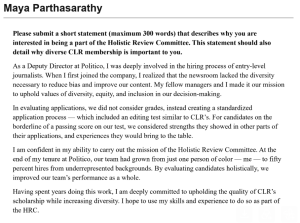
When Maya Parthasarathy, a student editor at the California Law Review, applied for the journal's admissions committee in 2025, she knew exactly what her colleagues wanted to hear. The post Inside Cal Berkeley Law Review’s Admissions Team, Where 'Diverse Life Experience' Matters More Than 'Editing Abilities' appeared first on .
Original source:
Read at Free BeaconHow We See It
New Republican Times Editorial Board
she knew what her colleagues on the California Law Review admissions committee wanted to hear, and she said it. That's not a scandal buried in leaked emails or a whistleblower tape. That's a student editor openly describing how you get picked for one of the most prestigious legal journals in the country. Not by writing clean, and not by catching errors other editors miss, but by performing the right kind of "diverse life experience" for the room.
Here's the part that should bother even people who like the goal of diversity on paper: editing ability is the actual job. A law review exists to check citations, tighten arguments, and make sure the footnotes hold up under a judge's or a clerk's scrutiny. If the people running admissions are candid that "editing abilities" rank below life-story credentials, they're telling us the mission has quietly changed. The masthead becomes a résumé exercise in identity rather than a workshop for producing rigorous legal scholarship.
None of this requires believing background is irrelevant. A first-generation student, a veteran, a single parent working nights through law school, those experiences shape how someone reads a case and what they notice in a record. Fine. But when the selection criteria are explicit enough that a student can walk in already knowing the script, you've built a system that rewards fluency in a particular vocabulary, not talent or judgment. That's not diversity of thought. It's uniformity dressed up as inclusion.
Berkeley Law can run its journal however it wants. But if editing quality keeps losing ground to storytelling about identity, don't be surprised when the scholarship, and the journal's credibility, start to slip too.
Commentary written with AI assistance by the New Republican Times Editorial Board.