

Jeffries pans Trump AI agreement as ‘entirely unenforceable’
This story raises questions about governance, accountability, and American values.
Hakeem Jeffries looked at a room full of American industry leaders committing to build the next generation of technology on our shores and saw a problem. His complaint? The agreement Trump reached with them is "entirely unenforceable.
New Republican Times Editorial Board
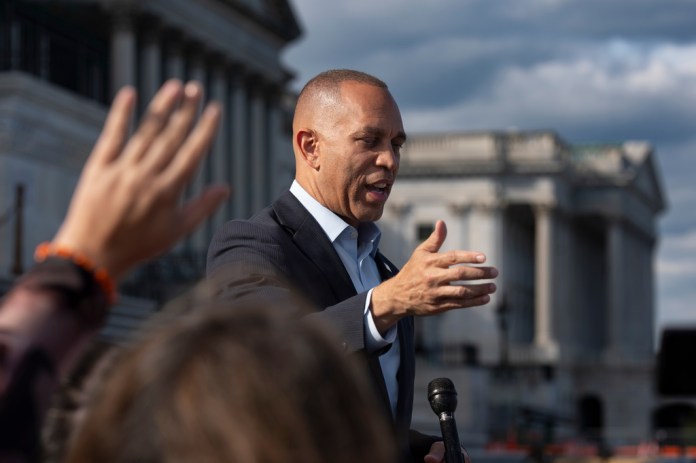
House Minority Leader Hakeem Jeffries (D-NY) dismissed the agreement President Donald Trump reached with top executives of artificial intelligence as “entirely unenforceable.” Jeffries, speaking to reporters on Wednesday, said the “notion of entering into a voluntary agreement that is entirely unenforceable and that allows the industry writ large to police itself is not the right […]
Original source:
Read at Washington ExaminerHow We See It
New Republican Times Editorial Board
Hakeem Jeffries looked at a room full of American industry leaders committing to build the next generation of technology on our shores and saw a problem. His complaint? The agreement Trump reached with them is "entirely unenforceable." That’s a strange thing to hear from a party that spent four years telling us we needed to trust the administrative state to manage every corner of the economy. Suddenly, the absence of a federal mandate is a crisis.
What Jeffries is really upset about is that the deal didn't go through the usual channels. There’s no multi-year study, no 1,200-page bill, and no opportunity for the regulatory class to weigh in. Instead, the President got the people actually building this stuff in a room and asked them to commit to safety standards without the government looting the process. For a guy like Jeffries, that’s a missed opportunity to secure a few more committee hearings. We see it differently: this is how you keep American innovation from being strangled by red tape. The alternative — the one the left prefers — is to let the EU set our tech policy or wait for a California regulator to invent new rules.
The "enforceable" argument is a dodge. The private sector has a far better record of adapting to threats than the federal government does, primarily because companies actually face consequences for failure. When the government "enforces" rules, it usually just means layers of lawyers and compliance officers get paid to slow things down. Trump’s approach trusts the builders, not the bureaucrats. If Jeffries thinks the industry needs a boot on its neck, he should say so outright. But he won't, because the American people are tired of the boot.
Ultimately, this is a fight about who gets to control the future. The Democrats want to ensure that nothing gets built without their permission, which is why they keep screaming about "guardrails" and "safety." The rest of us just want to see the next generation of medicine, computing, and defense developed in the United States. If the Minority Leader wants to spend his time lecturing us about unenforceable paper, he’s welcome to it. It’s a committee meeting, not a vision. Jeffries may think that dismissing a voluntary agreement makes him look tough, but to us, it just sounds like a man afraid of a future he doesn't get to tax first.
Commentary written with AI assistance by the New Republican Times Editorial Board.