

Poll: Voters favor Democrats on key issues but lack faith
This story raises questions about governance, accountability, and American values.
Aaron Siever from southwest Virginia is the most honest part of this whole poll. He says both parties are nothing but blame-gamers, and he is exactly the kind of voter who decides elections without ever appearing on cable news. The AP story tells us he is not a single-party guy, just a frustrated one.
New Republican Times Editorial Board
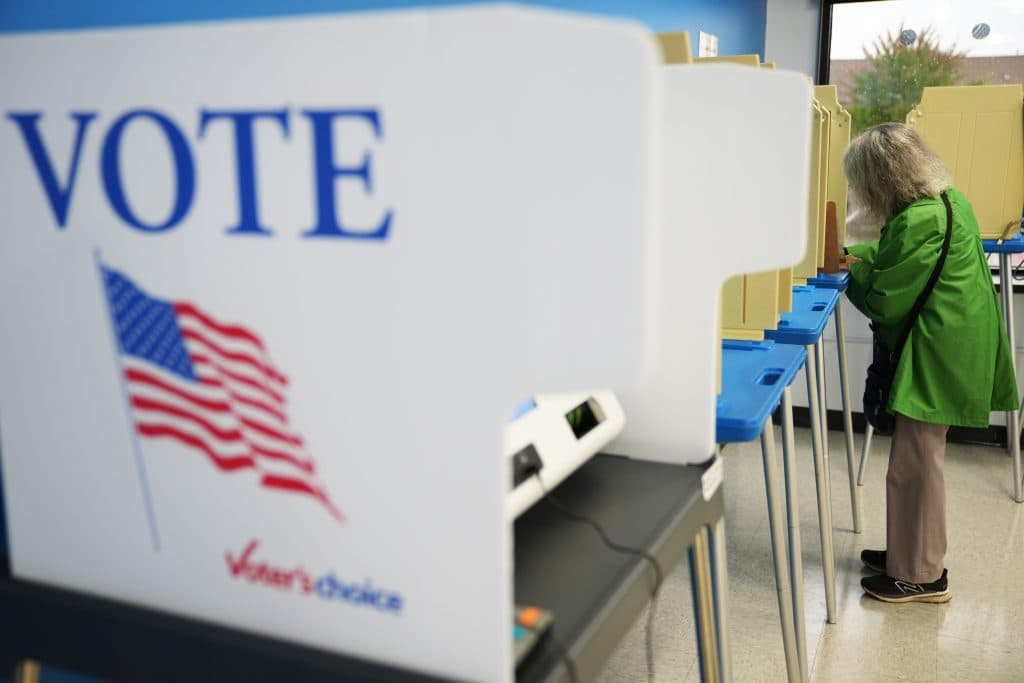
WASHINGTON — Aaron Siever was never a single-party voter. But now, the 41-year-old from southwest Virginia is more frustrated than ever with the two political parties whose chief accomplishment, he says, is blaming each other for getting little done. “There’s so much turmoil,” said Siever, a former police officer who now guides Civil War battlefield tours. “It really messes up chances of getting anything done.
It gets really disgusting.” Voters are deeply dissatisfied with President Donald Trump and his Republican Party heading into the Nov. 3 midterm elections, according to an Associated Press-NORC Center for Public Affairs Research poll, and Democrats have built a clear advantage on pressing issues such as the cost of living and healthcare over just a few months.
But the survey also points to a bigger problem for both parties: Few registered voters think either party is able to solve important problems or help Americans like them. That undercurrent of cynicism will be a challenge for the Democrats and the Republicans, no matter which party controls Congress.
Frustration with Republicans is growing, but voters do not appear to think Democrats have a long-term solution to the country’s problems, either. Democrats have gained on key issues, survey shows Voters give Democrats the advantage when it comes to which party would be better to handle the cost of living, an issue that has proved to be a weak spot for Trump.
The survey finds that 38% of registered voters say the Democrats would be better for costs, compared with 27% who say that about the Republicans. The issue was about evenly split among U.S. adults in February, with about 3 in 10 saying each party would be better.
Democrats have also gained ground on the economy. About 4 in 10 registered voters now pick the Democrats, compared with 26% of U.S. adults in February. These shifts are good news for Democratic candidates who are hammering an increasingly unpopular president — and by extension, his party.
Few Americans approve of Trump’s handling of the cost of living, and views of his performance on the economy are only a little better. Voters appear to view Republicans, in particular, as focused on the wealthy.
The survey finds that about 6 in 10 registered voters say the phrase “focused on helping rich and powerful people” describes the Republican Party “extremely” or “very” well. Only about 3 in 10 registered voters say the same about the Democratic Party.
Few voters think either party is focused on people like them While voters expressed deep dissatisfaction with Republicans, the survey indicates that voters have relatively little confidence Democrats have their problems in mind.
Democrats are less likely to be described as corrupt or focused on the wealthy than are Republicans, but not more likely to be seen as focused on ordinary people or capable of solving problems. Only about 2 in 10 registered voters say that “able to solve important problems” or “focused on helping people like me” describes the Democratic Party “extremely” or “very” well.
That is similar to the percentages who say this about the GOP. Democrats are out of power in Washington, and that may contribute to the perception that they are unable to get traction in solving problems.
In the last year alone, the federal government partially shut down twice for weeks because of partisan disputes in Congress over spending on healthcare and immigration enforcement. But gridlock has not been exclusive to Republican control.
Despite Democratic majorities early in President Joe Biden’s administration, the party did not achieve its goals on key priorities such as abortion rights, voting rights and raising the minimum wage. Siever is frustrated by what he sees as a commitment to partisanship in Congress at the expense of progress at a time when consumers are paying higher prices for daily necessities such as groceries and gasoline.
Driving around the region to lecture and guide tours, his travel costs have soared and led him to raise his prices. “I’ve really become tired of the idea that, if you’re in this party, you have to be loyal to this but, if you’re in that party, you have to be loyal to that,” he said. “There’s big problems and neither side seems able to fix them.” Meanwhile, 55% of registered voters say the Republican Party is “too extreme.” Some 45% say the same about the Democratic Party.
Democrats are divided on their party’s path forward Voters overall do not see an abundance of moderate sentiment in either party. But they are more likely to say Democrats are “too moderate” than Republicans — a reflection of the lack of unity within the Democratic Party about its strategy.
Slightly fewer than half of Democratic voters say their party is “too moderate,” while a similar share say it is “about right.” That is a sharp contrast with Republican voters, who mostly say their party is “about right.” Voters such as Meagan Ludwig of Milwaukee illustrate the party discontent that has emerged in Wisconsin and other closely contested states this year.
Ludwig, a 41-year-old real estate broker, voted for democratic socialist Francesca Hong in the Democratic primary for governor in August, arguing the candidate seemed more committed to a policy agenda aimed at helping working families than Milwaukee County Executive David Crowley.
Crowley won the primary by half a percentage point — roughly 3,800 votes — illustrating Democrats’ soul-searching in the upper Midwestern swing state. In the November general election, Ludwig is “reluctant,” but plans to vote for Crowley rather than Republican Tom Tiffany, a congressman.
Ludwig hopes that Crowley, if elected, perceives the discontent about his party. “We need to seize the opportunity to boldly enact policies that will improve the lives of Americans,” said Ludwig, who is married and has an elementary school-age child. “I’m tired of us pursuing incremental change.”
Original source:
Read at Vail Daily NewsHow We See It
New Republican Times Editorial Board
Aaron Siever from southwest Virginia is the most honest part of this whole poll. He says both parties are nothing but blame-gamers, and he is exactly the kind of voter who decides elections without ever appearing on cable news. The AP story tells us he is not a single-party guy, just a frustrated one. And that frustration is the real headline behind all the numbers.
The headline numbers are simple: voters say they trust Democrats more on abortion, health care, and climate. But the same survey says voters don't trust Democrats to be in charge. That is not a contradiction. That is the entire problem for the left. They can run on a list of issues, but nobody believes they can run the country. Maybe it's the open borders. Maybe it's the inflation. Maybe it's the feeling that they are more loyal to their slogan than to their constituents. Whatever it is, the policy edge is worthless without the confidence to go with it.
Republicans should not read this poll and smirk. It also tells us that people are exhausted with the same two parties blaming each other, and that includes some of our own voters. But the lesson here cuts against the Democrats harder than us. They keep thinking a stack of favorable issue numbers wins the day. It doesn't. Trust is earned by doing, not promising. And the only party with a recent record of actually securing the border, raising wages, and keeping the mullahs and despots scared is the one that was in office for four years.
Siever is not asking for much. He wants a party that takes responsibility and stops pointing fingers. That is a fair standard, and it should make every politician nervous. If Democrats had this poll a year ago, they would have plastered it everywhere. Now they can't figure out why people like their ideas but not their leadership. That gap is called character, and it is not something a focus group can fix.
Commentary written with AI assistance by the New Republican Times Editorial Board.