

Cuban government-linked activists form ‘rapid response’ protest plan in case Trump attacks island
This story raises questions about governance, accountability, and American values.
So the Cuban government has a rapid response team ready to activate American streets on its behalf, but somehow it's American conservatives who get accused of being paranoid about foreign influence operations. The National Network on Cuba didn't hide the ball here. They wrote a document, a real "National Rapid Response Plan," explicitly built to mobilize protesters in the United States within 24 hours if Washington moves against Havana.
New Republican Times Editorial Board
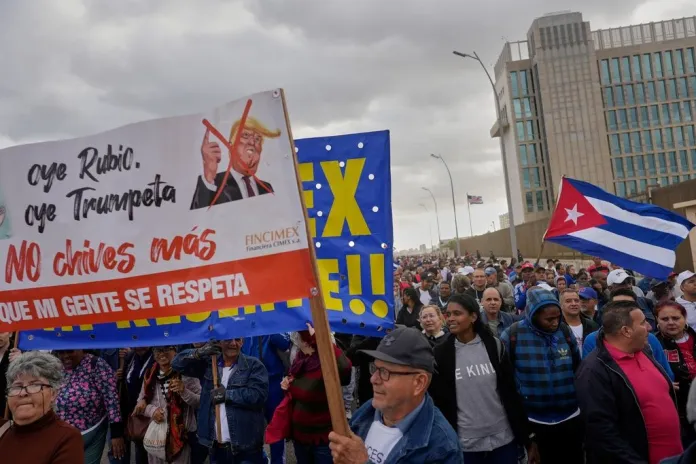
A Cuban government-linked group has a “National Rapid Response Plan” in place for protesters to fill American streets if the U.S. military attacks the communist regime. The National Network on Cuba gave strategies for “coordinated nationwide actions within 24 hours” of such an event in a document sent to supporters and obtained by the Washington […]
Original source:
Read at Washington ExaminerHow We See It
New Republican Times Editorial Board
So the Cuban government has a rapid response team ready to activate American streets on its behalf, but somehow it's American conservatives who get accused of being paranoid about foreign influence operations. The National Network on Cuba didn't hide the ball here. They wrote a document, a real "National Rapid Response Plan," explicitly built to mobilize protesters in the United States within 24 hours if Washington moves against Havana. That's not grassroots organizing. That's a foreign regime pre-staging a domestic pressure campaign and being open enough about it to put it in writing.
What's remarkable is how familiar the playbook is. Every time there's a whiff of American pressure on Cuba, the same clusters of activist groups suddenly discover deep concern about "imperialism" and "solidarity," timed suspiciously well with Havana's political needs. Nobody's saying every person who shows up to protest is a paid asset of the regime. But the infrastructure being described here isn't spontaneous conscience. It's choreography, built in advance, by a network tied to the very government it's defending.
This is also a useful reminder of what these groups actually are. They're not neutral human rights observers wringing their hands over Cuban political prisoners, of which there are plenty rotting in cells for the crime of protesting their own government. They're logistics arms for a dictatorship that jails dissidents and rations electricity while insisting the real threat to Cuba is Washington. If Havana has energy to spare for coordinating 24-hour American street mobilizations, it can spare some for keeping the lights on in Santiago.
None of this means the U.S. should be careless about how or whether it escalates with Cuba. But policy debates should happen with eyes open about who's shaping the narrative and why. When a communist government's allies are drafting rapid response protest plans for American cities, that's not civic engagement. That's the regime doing PR through American proxies, and it deserves to be called exactly that.
Commentary written with AI assistance by the New Republican Times Editorial Board.